Emma Chandler’s Purple Belt at 15 Marks an Early Advanced Milestone
Emma Chandler earned her Brazilian jiu-jitsu purple belt at 15, reaching an advanced rank at an unusually early point in the sport’s age structure. The promotion deserves attention without exaggeration: it is a meaningful recognition of development already achieved and the beginning of a more demanding phase ahead.
An early step into advanced jiu-jitsu
Purple changes the frame around an athlete. In the older-athlete hierarchy described by the International Brazilian Jiu-Jitsu Federation, it comes after white and blue and before brown and black. Chandler’s promotion therefore represents more than movement from one belt color to another. It places her beyond the foundational ranks at an unusually early chronological age.
The available sources do not provide a global dataset that can turn this accomplishment into a rarity percentage, and there is no need to manufacture one. Within the established age-and-rank structure, earning purple at 15 is plainly an early milestone. Its significance comes from where the rank sits, when Chandler reached it and what that combination reasonably suggests about the development required to arrive there.
The thoughtful editorial reading is that the promotion is consistent with sustained progress and recognition of an advanced stage in her jiu-jitsu. It is not a prediction of titles or a declaration that her path is already written. A purple belt signals that substantial work has been completed; it also raises the level of work expected next.
How the age framework works
IBJJF’s graduation system lists 16 as the minimum purple-belt age, but it calculates age by subtracting an athlete’s birth year from the current year. That means someone who is chronologically 15 may count as 16 during the year in which they will turn 16. Without Chandler’s birth year, that rule does not establish how the federation would count her age or prove eligibility; the available information also does not establish the promotion date or administrative circumstances.
Achievement without a finish line
What makes an early purple belt compelling is not the temptation to project a distant future. It is the amount of developmental runway now opening at an advanced rank. Chandler has reached a point from which refinement, adaptation and deeper technical connection can continue over time.
That perspective preserves the accomplishment rather than diminishing it with inflated claims. The belt stands as recognition of progress already made, while its position below brown and black keeps the larger journey visible. In combat sports, the most durable milestones often carry both messages at once: you have come a long way, and the standard has just risen.
A keepsake in matching purple
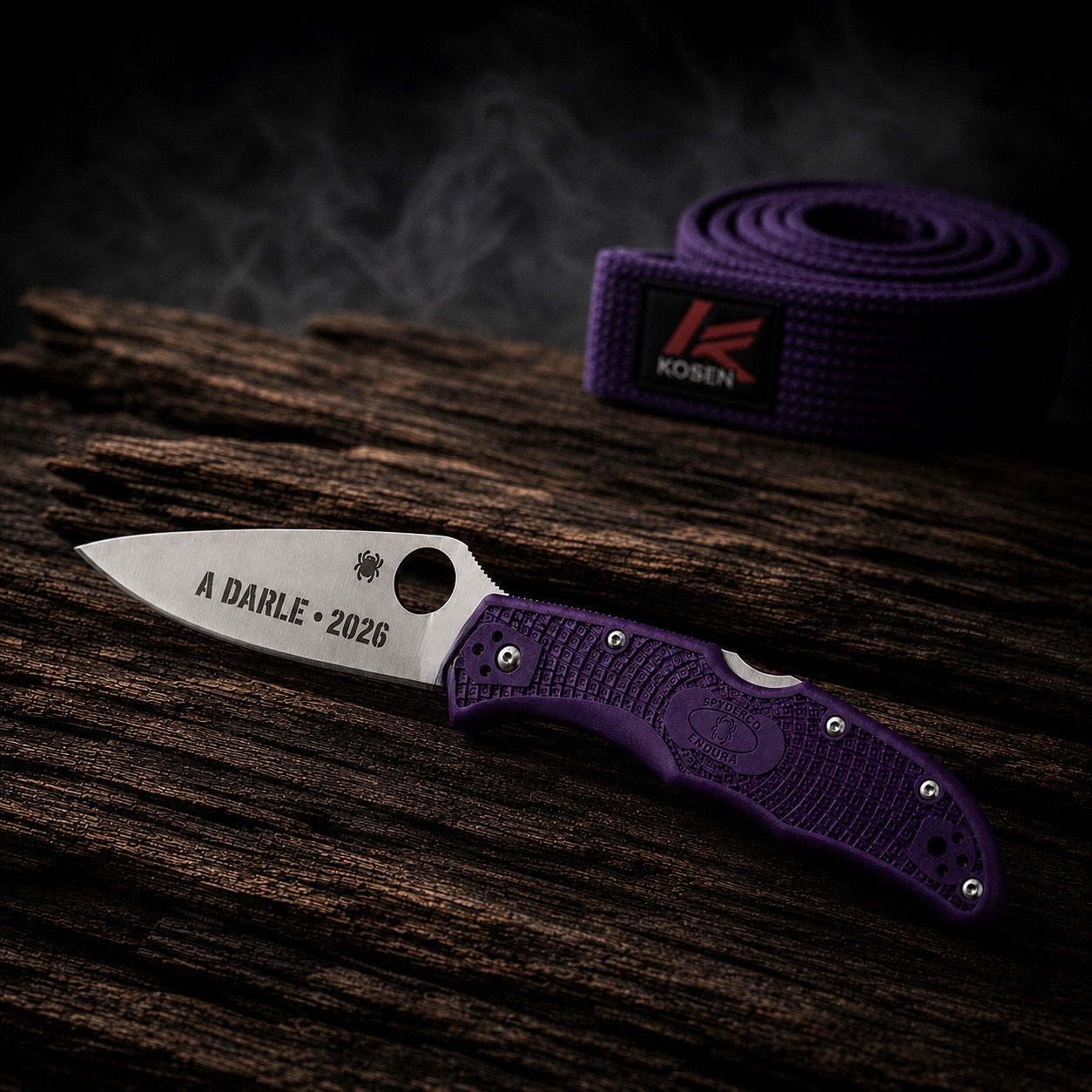
The photograph accompanying the story gives that milestone a personal symbol. Chandler’s purple belt sits beside the purple-handled Spyderco folding knife she received as a gift when she earned the rank. The blade bears the engraving “A DARLE • 2026,” with the Spyderco spider mark and handle text also visible.
The knife is best understood as a commemorative keepsake, not a credential or commercial endorsement. Its matching color ties it immediately to the promotion, turning an abstract point in Chandler’s development into an object she can carry forward. The belt marks the rank; the gift preserves the moment.
Together, they make a concise portrait of transition. One object belongs to the work itself, the other to the memory of being recognized for it. For Chandler, purple arrived early—and the keepsake gives that important beginning a form that can endure long after promotion day.